Juneteenth 2026 falls on Friday, June 19, 2026. This federal holiday commemorates June 19, 1865, when enslaved African Americans in Galveston, Texas learned of their freedom through General Order No. 3, delivered by Union Major General Gordon Granger.
The 2026 observance creates a three-day weekend, marking 161 years since the announcement that ended slavery enforcement in the last Confederate state.
Table of Contents
When Is Juneteenth 2026?
Juneteenth 2026 occurs on Friday, June 19, 2026. The holiday always falls on June 19, commemorating the specific date in 1865 when freedom reached Texas.
Federal observance moves to the nearest weekday when June 19 falls on a weekend, but in 2026, the date aligns with a Friday, creating natural three-day weekend conditions.
How Many Days till Juneteenth Holiday 2026?
Below is the countdown to Juneteenth Holiday 2026, according to the June 2026 Calendar.
Juneteenth Federal Holiday Status
Juneteenth became a federal holiday on June 17, 2021 when President Joe Biden signed the Juneteenth National Independence Day Act into law.
This made Juneteenth the 11th federal holiday, the first new addition since Martin Luther King Jr. Day in 1983.
Federal observance details:
- Federal government offices close
- Federal employees receive paid time off
- United States Postal Service suspends mail delivery
- Federal Reserve member banks close
- Stock markets (NYSE, NASDAQ) close
- Federal courts suspend operations
State-level observance: All 50 states and the District of Columbia recognize Juneteenth either as a state holiday or official observance as of 2023. Individual state policies determine whether state government employees receive paid leave.
Private sector observance: No federal law requires private employers to observe federal holidays or provide paid time off. Employer policies vary significantly. According to a 2023 Society for Human Resource Management survey, 34% of U.S. companies offered Juneteenth as a paid company holiday, increasing from 9% in 2020.
Is June 19, 2026 a Bank Holiday?
Yes, federal banks close on Juneteenth 2026. All Federal Reserve member banks observe the federal holiday, suspending operations on Friday, June 19, 2026. State-chartered banks and credit unions follow varying policies, though most major financial institutions now close for Juneteenth.
Financial services impacted:
- Branch banking: Closed at most institutions
- ATM access: Available for withdrawals and deposits
- Online banking: Fully operational
- Mobile banking: Fully operational
- Wire transfers: Federal Reserve wire systems closed; international wires may process
- Check clearing: Delayed by one business day
Bill payment considerations: Automatic payments scheduled for June 19, 2026 may process on June 20, 2026 depending on financial institution policies and payment type.
What Is Juneteenth?
Juneteenth commemorates the emancipation of enslaved African Americans in Texas on June 19, 1865. The holiday marks the day Union troops arrived in Galveston, Texas and announced enforcement of the Emancipation Proclamation, which President Abraham Lincoln had signed two and a half years earlier on January 1, 1863.
Juneteenth Name Origin
The name “Juneteenth” combines “June” and “nineteenth”, creating a portmanteau that identifies the specific date of emancipation announcement in Texas. Alternative historical names include Freedom Day, Emancipation Day, Jubilee Day, and Black Independence Day. The term “Juneteenth” gained widespread usage in Texas during the late 1800s and spread nationally through the 20th century.
Why the 2.5-Year Delay Matters
Enslaved people in Texas remained in bondage for 30 months after the Emancipation Proclamation due to multiple interconnected factors:
Legal limitations: The Emancipation Proclamation of January 1, 1863 declared freedom only for enslaved people in Confederate states actively in rebellion. The proclamation required Union military presence to enforce its provisions. Confederate states rejected the proclamation’s authority, making enforcement dependent on Union troop advancement.
Geographic isolation: Texas occupied the westernmost Confederate territory, separated from major Civil War battlefields by hundreds of miles. Union military resources focused on eastern theaters of war through 1864. Confederate forces in Texas remained largely intact until the war’s conclusion at Appomattox Court House on April 9, 1865.
Information suppression: Slave owners in Texas deliberately withheld emancipation news from enslaved people. The absence of Union troops enabled continued slavery enforcement through intimidation and violence. Some Texas slaveholders relocated to the state specifically to evade Union forces and emancipation enforcement in other regions.
Military enforcement timing: Union forces under Major General Gordon Granger arrived in Galveston on June 18, 1865. Granger issued General Order No. 3 on June 19, 1865, providing the military authority necessary to enforce emancipation in Texas.
The delay demonstrates the distinction between legal emancipation declarations and practical freedom enforcement. This gap explains why Juneteenth holds particular significance as the moment when legal freedom became enforced reality for approximately 250,000 enslaved people in Texas.
Juneteenth History: From 1865 to Federal Recognition
The first Juneteenth celebration occurred in Texas on June 19, 1866, exactly one year after General Order No. 3 announced freedom in Galveston. Early celebrations combined religious services, family gatherings, communal meals, and public readings of the Emancipation Proclamation.
June 19, 1865: General Order No. 3
Major General Gordon Granger arrived in Galveston, Texas on June 18, 1865 with approximately 2,000 Union troops. On June 19, 1865, Granger read General Order No. 3 at Ashton Villa, announcing federal enforcement of emancipation.
General Order No. 3 text:
“The people of Texas are informed that, in accordance with a proclamation from the Executive of the United States, all slaves are free. This involves an absolute equality of personal rights and rights of property between former masters and slaves, and the connection heretofore existing between them becomes that between employer and hired labor. The freedmen are advised to remain quietly at their present homes and work for wages. They are informed that they will not be allowed to collect at military posts and that they will not be supported in idleness either there or elsewhere.”
The order established three critical elements: freedom declaration, employment relationship transformation, and behavioral expectations for newly freed people. Historical accounts describe varied reactions among enslaved people receiving this news, ranging from jubilation to confusion about practical next steps.
Early Juneteenth Traditions (1866-1900)
Texas African American communities established annual Juneteenth observances beginning in 1866. Early celebrations featured specific recurring elements:
Religious observances: Church services, prayer gatherings, and spiritual hymn singing opened most Juneteenth celebrations. African American denominations, particularly African Methodist Episcopal and Baptist congregations, organized community-wide services.
Public readings: Community leaders read the Emancipation Proclamation, General Order No. 3, and eventually the Thirteenth Amendment at public gatherings. These readings maintained historical awareness across generations.
Communal meals: Large outdoor gatherings featured shared food, particularly barbecue, which became a Juneteenth tradition. Red foods and beverages gained symbolic importance, representing resilience and sacrifice.
Land purchases for celebration: African American communities in Houston, Texas purchased property specifically for Juneteenth gatherings. In 1872, former enslaved people pooled $800 to purchase 10 acres, creating Emancipation Park. This pattern repeated in other Texas cities, establishing dedicated spaces for annual celebrations.
The Great Migration and National Spread (1910-1970)
Juneteenth observance expanded beyond Texas during the Great Migration (approximately 1916-1970), when six million African Americans relocated from Southern states to Northern, Midwestern, and Western urban centers. Texas migrants brought Juneteenth traditions to cities including Chicago, Los Angeles, Detroit, and New York.
Geographic spread patterns:
- 1920s-1930s: Juneteenth celebrations established in California, particularly Los Angeles
- 1940s-1950s: Midwestern cities developed Juneteenth observances
- 1960s: Civil Rights Movement renewed interest in Juneteenth’s historical significance
- 1970s: Juneteenth recognition appeared in multiple state legislative discussions
Texas State Holiday Recognition (1980)
Texas Representative Al Edwards introduced House Bill 1016 in 1979, proposing Juneteenth as an official state holiday. Edwards, representing Houston’s Fifth Ward district, argued that Texas should formally recognize the historical event that occurred within its borders.
Legislative timeline:
- 1979: HB 1016 introduced in Texas House of Representatives
- January 1, 1980: Juneteenth became official Texas state holiday
- Al Edwards earned the designation “Father of Juneteenth” for this legislative achievement
Texas became the first state to establish Juneteenth as an official holiday, creating momentum for recognition in other states over subsequent decades.
Opal Lee and the Federal Holiday Campaign
Opal Lee of Fort Worth, Texas began her organized campaign for federal Juneteenth recognition in 2016 at age 89. Lee’s advocacy included petition drives, public walks, and direct engagement with Congress members.
Biographical information:
- Born: October 7, 1926 in Marshall, Texas
- Age in 2026: 99 years old (turning 100 in October 2026)
- Key activism: Walked from Fort Worth to Washington, D.C. in 2016
- Petition achievement: Gathered 1.5 million signatures supporting federal recognition
Symbolic walk tradition: Lee walks 2.5 miles annually on June 19, representing the 2.5 years between the Emancipation Proclamation and Texas enforcement. This tradition, known as “Opal’s Walk,” occurs at Farrington Field in Fort Worth and attracts thousands of participants annually.
Lee attended the White House signing ceremony on June 17, 2021 when President Biden signed the Juneteenth National Independence Day Act, fulfilling her decades-long advocacy goal.
Federal Holiday Designation (2021)
The U.S. Senate passed the Juneteenth National Independence Day Act unanimously on June 15, 2021. The House of Representatives approved the legislation 415-14 on June 16, 2021. President Biden signed the act into law on June 17, 2021, making Juneteenth the first new federal holiday since Martin Luther King Jr. Day (established 1983).
Legislative sponsors:
- Senate: Senator Edward Markey (Massachusetts)
- House: Representative Sheila Jackson Lee (Texas)
The rapid legislative passage reflected decades of state-level recognition and grassroots advocacy. By 2021, 47 states already recognized Juneteenth in some official capacity, creating national momentum for federal action.
Juneteenth Symbols and Cultural Significance
Juneteenth cultural symbols include the Juneteenth flag, traditional foods, music, and color symbolism that developed through 150+ years of celebration traditions.
The Juneteenth Flag
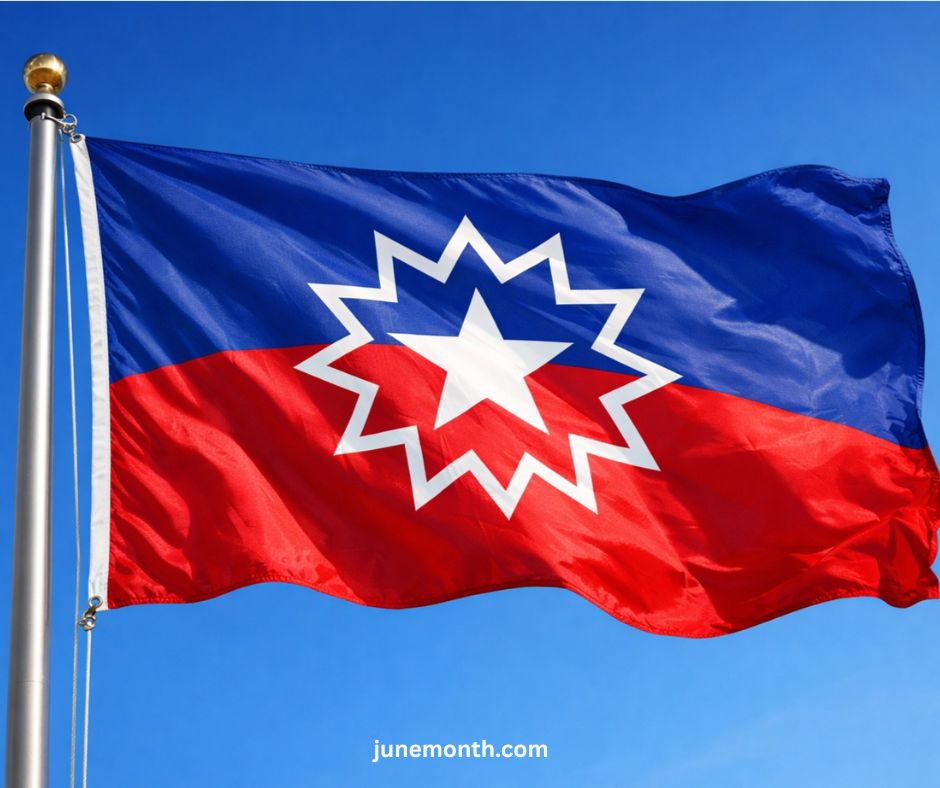
Ben Haith of Boston, Massachusetts created the Juneteenth flag in 1997. The National Juneteenth Celebration Foundation (NJCF) held a flag design competition, and Haith’s design won official selection. The flag received revisions and refinements in subsequent years, with the current standardized version established by 2000.
Flag design elements:
Colors:
- Red: Represents the blood shed by enslaved ancestors and resilience through suffering
- White: Symbolizes the promise of freedom and equality
- Blue: Represents hope, prosperity, and the new horizon of freedom
Star: A white star centered within a bursting nova against the blue field. The star represents Texas, the location where emancipation enforcement occurred, and extends symbolically to represent African American freedom throughout all 50 states.
Bursting nova: The star burst surrounding the central star symbolizes new freedom, new people, and new beginnings. The burst represents the expanding impact of emancipation from its Texas origin across the nation.
Arc: A curved horizon line separates the flag’s upper and lower portions, representing new horizons and the forward-looking nature of freedom.
Date: Some flag versions include “June 19, 1865” text, though this element varies across different flag manufacturers.
Juneteenth Flag vs. Pan-African Flag
The Juneteenth flag and Pan-African flag represent distinct concepts with different origins, designs, and meanings. Confusion between these flags occurs frequently in media coverage and public discussions.
| Feature | Juneteenth Flag | Pan-African Flag |
|---|---|---|
| Colors | Red, White, Blue | Red, Black, Green |
| Created | 1997 (Ben Haith) | 1920 (Marcus Garvey/UNIA) |
| Represents | U.S. emancipation/Juneteenth | Global African diaspora |
| Central Symbol | White star with burst | No central symbol (horizontal stripes) |
| Geographic Scope | United States focus | International/Pan-African |
| Design Pattern | Star field similar to U.S. flag | Three equal horizontal stripes |
Pan-African flag meaning:
- Red: Blood shed for liberation
- Black: Black people and African diaspora
- Green: Natural wealth of Africa and hope
Both flags appear at Juneteenth celebrations, reflecting the dual identity many African Americans hold as both specifically American and part of the global African diaspora. The flags serve complementary rather than competing purposes.
Traditional Juneteenth Colors
Red, white, and blue serve as official Juneteenth colors, matching the flag design. These colors deliberately echo the American flag, asserting that freedom’s promise belongs equally to African Americans as full citizens.
Red holds particular cultural significance beyond the flag’s official symbolism. Red foods and beverages became Juneteenth traditions with multiple layered meanings:
West African origins: Enslaved people brought from Senegambian regions used red palm oil, hibiscus drinks (bissap), and red kola nuts in celebratory contexts. These traditions transferred to American celebrations through cultural memory.
Symbolic representations: Red represents blood shed during slavery, resilience and strength of survivors, and sacrifice across generations. The color also connects to agricultural traditions, as June marks peak strawberry season in Texas, making red fruits abundant during early Juneteenth celebrations.
“Lift Every Voice and Sing”
“Lift Every Voice and Sing” functions as the Black National Anthem and frequently accompanies Juneteenth observances. James Weldon Johnson wrote the lyrics in 1900, and his brother John Rosamond Johnson composed the music. The song premiered at a celebration of Abraham Lincoln’s birthday on February 12, 1900 in Jacksonville, Florida.
Historical significance: The NAACP adopted “Lift Every Voice and Sing” as the Black National Anthem in the 1920s. The song appears in African American church hymnals and serves as a cultural touchstone across generations. Many Juneteenth ceremonies include the song alongside or before the U.S. National Anthem.
Juneteenth Food Traditions and Recipes
Traditional Juneteenth foods emphasize red-colored dishes, barbecue, and soul food preparations that developed through Texas African American communities in the late 1800s. These culinary traditions carry historical significance and symbolic meaning.
Why Red Foods Dominate Juneteenth Celebrations
Red foods represent multiple interconnected meanings in Juneteenth culinary traditions:
West African cultural continuity: Enslaved people from Senegambian regions brought traditions of using red ingredients in celebratory contexts. Red palm oil, hibiscus beverages (known as bissap in Senegal), and red kola nuts held ceremonial importance. These practices adapted to available American ingredients while maintaining symbolic color associations.
Blood and sacrifice symbolism: Red represents the blood African Americans shed during slavery, the Middle Passage, and ongoing struggles for equality. The color acknowledges generational trauma while celebrating survival and resilience.
Seasonal availability: June strawberry season in Texas provided abundant red fruit during the first Juneteenth celebrations. This practical availability reinforced symbolic color choices.
Visual impact: Red foods create immediate visual distinction for Juneteenth gatherings, marking the occasion as specifically commemorative rather than routine social gathering.
Traditional Juneteenth Red Foods
Red beverages:
- Strawberry soda: Big Red (Texas-origin soda brand) and strawberry-flavored sodas became Juneteenth staples
- Red punch: Fruit punch combinations featuring strawberries, watermelon, or hibiscus
- Strawberry lemonade: Fresh strawberry-infused lemonade
- Hibiscus tea (Agua de Jamaica): Cold hibiscus flower tea, connecting to West African bissap traditions
- Red Kool-Aid: Emerged as accessible red beverage option in 20th century celebrations
Red desserts:
- Red velvet cake: Chocolate cake with red food coloring, cream cheese frosting
- Strawberry pie: Fresh strawberry pie marking seasonal fruit availability
- Watermelon: Sliced fresh watermelon or watermelon-based desserts
Red main dishes and sides:
- Red beans and rice: Louisiana Creole influence in Texas celebrations
- Barbecue sauce: Red-hued sauces for smoked and grilled meats
- Hot links: Red-cased sausages common in Texas barbecue traditions
Classic Juneteenth Barbecue Traditions
Barbecue forms the centerpiece of most Juneteenth meals, reflecting Texas regional traditions and the outdoor communal nature of early celebrations.
Traditional barbecue proteins:
- Beef brisket: Texas-style slow-smoked brisket with dry rub seasoning
- Pork ribs: Spare ribs or baby back ribs with regional sauce variations
- Chicken: Whole chickens or chicken quarters
- Hot links: Spicy beef or pork sausages
- Pulled pork: Slow-cooked pork shoulder
Essential barbecue accompaniments:
- Potato salad: Mustard-based or mayonnaise-based variations
- Coleslaw: Vinegar-based or creamy preparations
- Baked beans: Slow-cooked beans with molasses and brown sugar
- Cornbread: Sweet or savory cornbread variations
- Collard greens: Slow-cooked greens with smoked meat
- Mac and cheese: Baked macaroni and cheese casserole
- Black-eyed peas: Traditional throughout African American Southern cuisine
Juneteenth Soul Food Menu
Soul food traditions intersect with Juneteenth celebrations, particularly as the holiday spread beyond Texas during the Great Migration.
Traditional soul food dishes:
- Fried chicken: Southern-style seasoned and fried chicken
- Fried catfish: Cornmeal-breaded catfish, traditional in Texas and Southern states
- Candied yams: Sweet potatoes baked with butter, sugar, and spices
- Greens: Collard greens, mustard greens, or turnip greens
- Cornbread dressing: Savory cornbread-based stuffing
- Peach cobbler: Southern fruit cobbler dessert
- Sweet potato pie: Traditional African American pie preparation
How to Celebrate Juneteenth 2026
Juneteenth 2026 offers unique celebration opportunities because the Friday, June 19 date creates a natural three-day weekend for many Americans. Authentic celebration combines education, community engagement, cultural expression, and reflection on ongoing freedom struggles.
Friday, June 19, 2026: Juneteenth Day Observance
Attend local Juneteenth events and gatherings. Most cities with significant African American populations host official Juneteenth celebrations including parades, festivals, and community gatherings. Contact local NAACP chapters, African American cultural centers, or city recreation departments for event information.
Participate in educational programming. Many libraries, museums, and community centers offer Juneteenth lectures, film screenings, and historical presentations. The National Museum of African American History and Culture in Washington, D.C. provides special Juneteenth programming annually.
Support Black-owned businesses. Dedicate June 19 spending to Black-owned restaurants, retailers, and service providers. Use directories like Official Black Wall Street, WeBuyBlack, or EatOkra to locate Black-owned businesses in your area.
Engage in ancestor remembrance. African American families may incorporate ancestor remembrance into Juneteenth observance, acknowledging family members who experienced slavery or its immediate aftermath. This can include storytelling, photograph sharing, or symbolic gestures honoring family history.
Watch Juneteenth-focused media. Films, documentaries, and television programming about emancipation, Reconstruction, and African American history provide educational context. Examples include “Juneteenth: A Celebration of Overcoming” (History Channel), “Juneteenth: Faith and Freedom” (PBS), and historical dramas addressing the era.
Saturday and Sunday, June 20-21, 2026: Extended Weekend Activities
Host or attend community cookouts. Juneteenth cookouts serve as social gathering opportunities featuring traditional foods, music, and intergenerational connection. Plan menus emphasizing red foods, barbecue, and soul food traditions.
Participate in cultural festivals. Major cities host multi-day Juneteenth festivals featuring live music, vendor markets, children’s activities, and cultural performances. Research festivals in your region during spring 2026 for planning purposes.
Visit African American historical sites. Use the extended weekend to visit museums, monuments, or historical locations significant to African American history. The National Juneteenth Museum in Fort Worth, Texas (opening expected in 2026) will become a primary destination for Juneteenth weekend visitors.
Engage in community service. Volunteer with Black-led community organizations, participate in neighborhood improvement projects, or contribute to causes addressing racial equity and justice.
Create family traditions. Establish personal or family Juneteenth traditions that can continue annually, such as specific recipes, readings, or activities connecting younger generations to the holiday’s significance.
Juneteenth 2026 Major Events and Destinations
Galveston, Texas hosts the most historically significant Juneteenth celebrations as the location where General Order No. 3 was read in 1865.
Galveston Juneteenth events:
- Historical walking tours of emancipation sites
- Juneteenth parade (typically Sunday of Juneteenth weekend)
- Celebrations at Emancipation Park (now named Reedy Chapel-AME Church Historical District)
- Gospel celebrations at The Grand 1894 Opera House
- Educational programming at the Galveston Island Railroad Museum and other cultural institutions
Fort Worth, Texas serves as home to Opal Lee and the forthcoming National Juneteenth Museum.
Fort Worth Juneteenth events:
- Opal’s Walk: 2.5-mile commemorative walk at Farrington Field
- National Juneteenth Museum opening (expected 2026)
- Community festivals in historic neighborhoods
- Educational programming highlighting local Juneteenth history
Atlanta, Georgia hosts one of the largest Juneteenth celebrations in the United States.
Atlanta Juneteenth events:
- Juneteenth Atlanta Parade and Music Festival at Piedmont Park
- Multi-day festival featuring national musical acts
- Vendor markets showcasing Black-owned businesses
- Children’s zones with educational activities
- 5K Freedom Run
Washington, D.C. features national-level Juneteenth observances.
Washington D.C. Juneteenth events:
- Special programming at National Museum of African American History and Culture
- Emancipation Proclamation display at National Archives
- Community celebrations in historic African American neighborhoods
- Congressional events and federal observances
Philadelphia, Pennsylvania maintains long-standing Juneteenth traditions.
Philadelphia Juneteenth events:
- Major parade along 52nd Street corridor
- Community festival in West Philadelphia
- Programming at African American Museum in Philadelphia
- Neighborhood block parties and gatherings
Juneteenth in the Workplace
Workplace Juneteenth observance increased significantly following the 2021 federal holiday designation. Organizations implement varying approaches ranging from paid time off to educational programming to community service initiatives.
Company Holiday Policies for Juneteenth
Federal employees receive paid time off for Juneteenth automatically as a designated federal holiday. Federal contractors typically follow federal holiday schedules, providing paid leave for workers on federal contracts.
Private sector policies vary extensively. According to Society for Human Resource Management data, approximately 34% of U.S. companies offered Juneteenth as a paid company holiday in 2023, compared to 9% in 2020. This represents significant growth but leaves majority of private-sector workers without guaranteed paid leave.
Industries showing higher Juneteenth observance rates:
- Technology companies: 60-70% offer paid holiday
- Financial services: 45-55% offer paid holiday
- Professional services: 40-50% offer paid holiday
- Healthcare: 25-35% offer paid holiday
- Retail and hospitality: 10-20% offer paid holiday
Alternative workplace accommodations: Companies not offering full paid holidays may provide floating holidays, half-day closures, or voluntary time off options for Juneteenth observance.
Authentic Workplace Juneteenth Programming
Effective workplace Juneteenth programming centers Black voices and experiences while avoiding performative gestures that lack substantive impact.
Recommended workplace initiatives:
Educational programming: Invite historians, educators, or community leaders with expertise in African American history to present Juneteenth context. Compensate speakers appropriately for their time and expertise. Avoid placing unpaid educational burden on Black employees.
Resource sharing: Provide curated reading lists, documentary recommendations, and historical resources employees can explore independently. Create optional discussion groups for interested employees.
Community partnership: Partner with Black-led community organizations for volunteer opportunities, donation matching, or service projects. Ensure partnerships provide genuine value to community organizations rather than serving primarily as company photo opportunities.
Black business support: Cater workplace events from Black-owned restaurants, source gifts or promotional items from Black-owned businesses, or organize group support of Black-owned establishments.
Policy review: Use Juneteenth as annual opportunity to review workplace equity policies, hiring practices, promotion pathways, and pay equity data. Share findings and improvement commitments with employees.
Voluntary participation: Make all Juneteenth programming optional rather than mandatory. Recognize that Black employees may prefer to observe the holiday privately rather than in workplace settings.
What Not to Do: Avoiding Tokenism
Performative workplace Juneteenth observance creates resentment among Black employees and demonstrates lack of genuine commitment to racial equity.
Practices to avoid:
Spotlighting Black employees: Do not ask Black employees to lead, explain, or represent African American perspectives on Juneteenth without their explicit consent and appropriate compensation. Educational labor constitutes actual work requiring acknowledgment and payment.
One-day commitment: Limiting anti-racism efforts to Juneteenth Day while maintaining discriminatory practices year-round represents tokenism. Juneteenth should complement ongoing equity work rather than substitute for it.
Profit-focused marketing: Using Juneteenth primarily as marketing opportunity or sales event commodifies African American liberation. Juneteenth sales promotions without accompanying donations to racial justice organizations demonstrate exploitative intent.
Incomplete historical narrative: Presenting sanitized Juneteenth history that avoids discussing slavery’s brutality, ongoing racism, or current racial inequities provides false comfort rather than genuine education.
Centering non-Black experiences: Juneteenth workplace observance should prioritize Black employees’ needs and perspectives. Programming that primarily serves non-Black employees’ curiosity or comfort misses the point.
Juneteenth Education for Children
Age-appropriate Juneteenth education helps children understand this important historical event and its continuing relevance while avoiding age-inappropriate trauma or complexity.
Explaining Juneteenth to Young Children (Ages 3-6)
Use simple, concrete language focusing on freedom and celebration. Young children grasp basic concepts of fairness, kindness, and happiness without needing detailed historical context.
Recommended explanation framework: “A long time ago, some people were not treated fairly and were not free. On June 19, people found out they were free. We celebrate that day because freedom is very important. Juneteenth reminds us to be kind to everyone.”
Appropriate activities for young children:
- Read picture books about freedom and Juneteenth
- Create freedom-themed art projects with red, white, and blue colors
- Learn songs celebrating freedom and joy
- Prepare red foods together (strawberry drinks, watermelon)
- Attend child-friendly community celebrations with music and activities
Recommended books for ages 3-6:
- “All Different Now: Juneteenth, the First Day of Freedom” by Angela Johnson
- “Juneteenth for Mazie” by Floyd Cooper
- “Opal Lee and What It Means to Be Free” by Alice Faye Duncan
Teaching Juneteenth to Elementary Students (Ages 7-12)
Elementary-age children can understand more detailed historical context including basic facts about slavery, the Civil War, and emancipation timeline.
Recommended explanation framework: “Between the 1600s and 1800s, millions of African people were enslaved in America. Slavery meant people were forced to work without pay and without freedom. During the Civil War, President Lincoln signed the Emancipation Proclamation on January 1, 1863, declaring enslaved people free. But this news took time to reach everywhere. On June 19, 1865, Union soldiers arrived in Galveston, Texas and told enslaved people they were free. This was the last place in America where people learned about freedom. We celebrate Juneteenth to remember this important day and to keep working for fairness and equality for everyone.”
Appropriate activities for elementary students:
- Create illustrated timelines showing 1863 Emancipation Proclamation, 1865 Juneteenth, and present day
- Research and report on historical figures (Opal Lee, Gordon Granger, freed Texas families)
- Interview family members about their Juneteenth memories or family history
- Write freedom-themed poetry or creative stories
- Participate in community service projects
- Learn about Juneteenth symbols (flag, traditional foods, colors)
Recommended books for ages 7-12:
- “Juneteenth” by Vaunda Micheaux Nelson
- “The True Story of Juneteenth” by Tonya Leslie
- “Juneteenth Jamboree” by Carole Boston Weatherford
- “Freedom’s Gift: A Juneteenth Story” by Valerie Wesley
Juneteenth Activities and Crafts for Kids
Hands-on activities help children engage with Juneteenth meaning through creative expression.
Flag creation project: Provide red, white, and blue construction paper, scissors, glue, and star stickers. Teach children the Juneteenth flag design and its symbolism while they create personal versions.
Freedom chain craft: Cut construction paper strips and help children write what freedom means to them on each strip. Connect strips into paper chains representing linked freedom for all people.
Timeline construction: Create visual timelines showing important dates: 1863 (Emancipation Proclamation), 1865 (Juneteenth), 1980 (Texas state holiday), 2021 (federal holiday), and present day.
Recipe preparation: Involve children in preparing traditional Juneteenth foods, particularly red dishes. Discuss food symbolism while cooking together.
Story collection project: Help children interview older family members about their Juneteenth memories or family history during slavery and emancipation periods. Record or write down stories for family archives.
Juneteenth Frequently Asked Questions
What does Juneteenth celebrate?
Juneteenth celebrates the emancipation of enslaved African Americans in Texas on June 19, 1865. The holiday marks the date Union troops arrived in Galveston and announced enforcement of the Emancipation Proclamation, freeing approximately 250,000 enslaved people in Texas. Juneteenth represents both historical commemoration and ongoing celebration of Black American freedom, culture, and resilience.
When did Juneteenth become a federal holiday?
President Biden signed the Juneteenth National Independence Day Act on June 17, 2021, establishing Juneteenth as the 11th federal holiday. The Senate passed the legislation unanimously on June 15, 2021, and the House approved it 415-14 on June 16, 2021. This made Juneteenth the first new federal holiday since Martin Luther King Jr. Day in 1983.
Is Juneteenth celebrated in all 50 states?
All 50 states and the District of Columbia recognize Juneteenth through either official state holiday designation or formal observance declaration as of 2023. Texas became the first state to establish Juneteenth as a state holiday in 1980. Recognition accelerated significantly from 2020-2021, with most remaining states adding recognition around the time of federal holiday designation.
Why is red food traditional for Juneteenth?
Red foods carry multiple layers of symbolism in Juneteenth traditions. Red represents blood shed by enslaved people, resilience and strength of survivors, and connects to West African cultural traditions where red palm oil and hibiscus drinks held ceremonial significance. Additionally, June strawberry season in Texas made red fruits naturally abundant during early Juneteenth celebrations, reinforcing the color association.
What is General Order No. 3?
General Order No. 3 is the military order read by Union Major General Gordon Granger in Galveston, Texas on June 19, 1865. The order announced that all enslaved people in Texas were free, established expectations for employment relationships between former enslavers and freed people, and instructed freed people to remain at their current locations and work for wages. This order provided the federal military enforcement mechanism that made emancipation practically effective in Texas.
Who is Opal Lee?
Opal Lee is a 99-year-old activist from Fort Worth, Texas known as the “Grandmother of Juneteenth”. Born October 7, 1926, Lee began her organized campaign for federal Juneteenth recognition in 2016 at age 89. She walked from Fort Worth to Washington, D.C. and gathered 1.5 million petition signatures supporting federal holiday designation. Lee attended the White House when President Biden signed the Juneteenth National Independence Day Act in 2021. She continues walking 2.5 miles annually on Juneteenth, symbolizing the 2.5 years between the Emancipation Proclamation and Texas enforcement.
How is the Juneteenth flag different from the Pan-African flag?
The Juneteenth flag uses red, white, and blue colors with a central white star, while the Pan-African flag features horizontal stripes of red, black, and green. Ben Haith created the Juneteenth flag in 1997 specifically commemorating African American emancipation in the United States. Marcus Garvey and the Universal Negro Improvement Association created the Pan-African flag in 1920, representing the global African diaspora. Both flags appear at Juneteenth celebrations serving complementary purposes.
Are private companies required to give Juneteenth as a paid holiday?
No federal law requires private employers to observe federal holidays or provide paid time off. Juneteenth designation as a federal holiday means federal government offices close and federal employees receive paid leave. Private sector companies establish their own holiday policies. Approximately 34% of U.S. private companies offered Juneteenth as a paid holiday in 2023, though this percentage varies significantly by industry and company size.
What happened on June 19, 1865?
Union Major General Gordon Granger arrived in Galveston, Texas with approximately 2,000 troops on June 18, 1865. On June 19, 1865, Granger read General Order No. 3 at Ashton Villa, informing enslaved people in Texas that they were free and that slavery had ended. This announcement came two and a half years after President Lincoln signed the Emancipation Proclamation and two months after Confederate surrender at Appomattox Court House ended the Civil War.
Can non-Black people celebrate Juneteenth?
Juneteenth welcomes participation from all Americans as a day for the nation to acknowledge African American freedom and ongoing racial justice work. Appropriate non-Black participation includes education about Juneteenth history, attending community celebrations respectfully, supporting Black-owned businesses, contributing to racial justice organizations, and reflecting on systemic racism’s continuing impacts. The holiday centers Black American experiences while inviting all Americans to engage with this crucial historical event.
Related: June 2026 Calendar | Father’s Day 2026 | Summer Solstice 2026 | June Birthstones
For further readings and research on Juneteenth, you can explore these authoritative websites which offer primary documents, digital toolkits, and scholarly articles.
Primary Historical Records & Federal Sources
- The National Archives: View high-resolution copies of General Order No. 3 (the actual order read in Galveston) and the Emancipation Proclamation. The site also provides context on the 13th Amendment and the legislative path to Juneteenth becoming a federal holiday.
- The Library of Congress: Features the “Voices of the Enslaved” project, which includes rare audio recordings and transcripts of formerly enslaved individuals reflecting on their lives.
- Congress.gov (CRS Reports): Provides a comprehensive Juneteenth Fact Sheet detailing the history, resolutions, and the 2021 National Independence Day Act.
Museums & Digital Toolkits
- National Museum of African American History and Culture (NMAAHC): Offers an extensive Digital Toolkit for 2026, including reading lists, virtual tours of the “Slavery and Freedom” exhibit, and guides for talking to children about the holiday.
- The National Juneteenth Museum: Based in Fort Worth, Texas, this site focuses on the future of Juneteenth education and the legacy of activist Opal Lee.
Texas-Specific & Scholarly Research
- Texas State Historical Association (TSHA): The definitive source for the Handbook of Texas, which covers the local history of emancipation in Galveston and the evolution of the holiday within the state.
- JSTOR Daily: Provides a curated collection of free scholarly articles that examine Juneteenth through the lenses of sociology, law, and folklore.
- Texas Historical Commission (THC): Features blogs and research specifically about the historic plantations where the news of freedom was first enforced.